

Vande Bharath

We go over all the prerequisites needed to acquire a fantastic job, from the ground up.
Providing complete assistance with the preparation to crack the interviews
We are assisting in finding better and more relevant job openings.
Through guidance ensures the students gain the best out of the course.
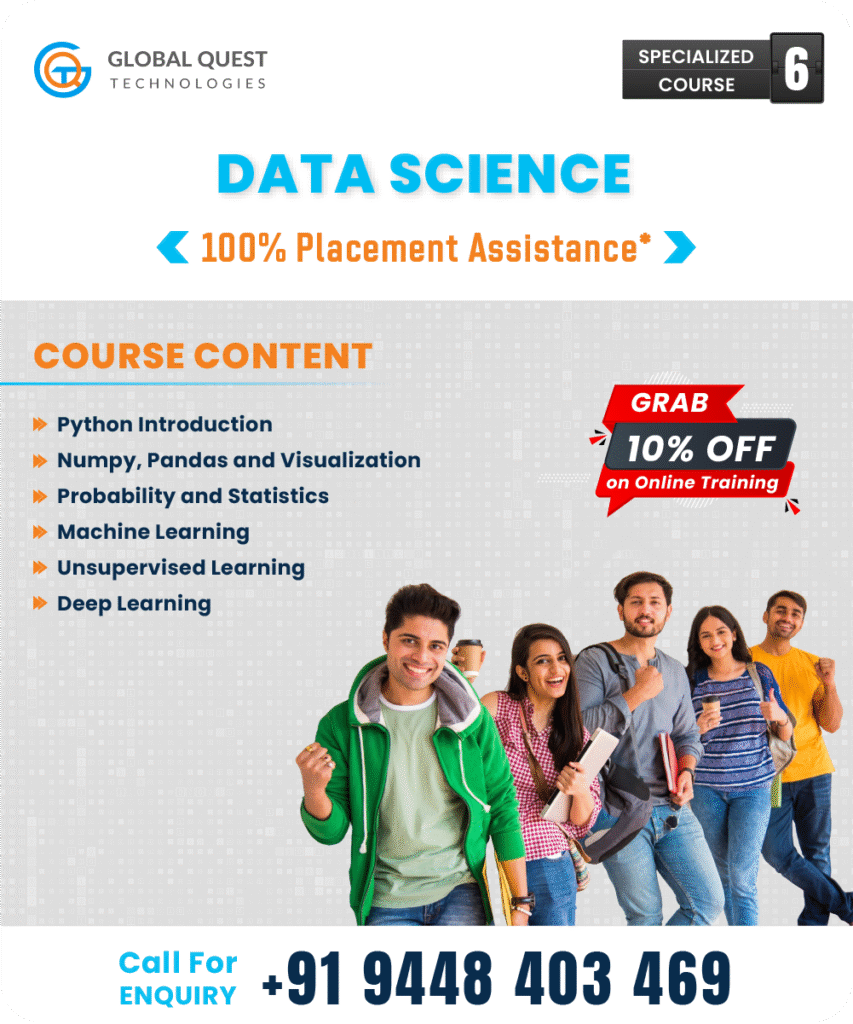
Our institute provides easy-to-follow data science training, covering machine learning, data analysis, and statistics. With practical projects and expert guidance, we help you gain real skills to kickstart your career in data science. Join us for hands-on learning and support every step of the way!

In 2005, Syed Mahmood obtained a degree in electronics engineering.He is almost ten years experienced in Excel, Robotics, and Gen AI. He works as a data science trainer.

Mr. Subramanya Swamy H N has been implementing his passion towards teaching from the past 10+ years. He teaches any complex topic in a very simpler manner by giving real time examples such that even naive can easily understands the subject in a crystal clear manner. He is handling Java Full Stack Development, Python Full Stack Development, Devops with AWS, Dotnet Full Stack Development.
• List and Tuples
• Sets and Dictionaries
• Associated Methods
• If -elif -else
• Nested Conditions
• AND , OR Operations
• For and while loops
• Loop Counters
• Loops with conditions
• Nested loops
• Functions with parameters
• Functions with return
• Closures
• Recursive functions
• Object and Methods
• Polymorphism
• Abstract Methods
• Compositions
• Indexing/ Slicing
• Broadcasting
• Appending/ Inserting on Axis
• Mathematical and Statistical operations
• Sort/ Conditions
• Transpose operations
• Joining/ Splitting
• Linear Algebra
• Data Extraction
• Series/ DataFrame Creations
• Indexing and Slicing
• Conditions/ Grouping/ Imputation
• Append/ Concat/ Merge/ Join
• DateTime Functionalities and Resampling
• Window Functions
• Excel functions
• Customization of Matplotlib/ Seaborn
• Scatterplots/ Barplots/ Histograms/ Density Plots
• 3D plots
• Boxplotting and Outlier Detection
• Visualizing Linear Relationships
• Plotting with Pandas
• Probability
• Basics( Mutually Exclusive/ Joint Probability)
• Conditional Probability
• Dependent/ Independent
• Logs/ Odds
• Bayes Theorem
• Descriptive/ Inferential
• Mean, Median, Mode
• Variance/ Standard Deviation
• Co-variance/ Correlation (Pearson/ Spearman)
• PDF/ PMF/ CDF
• Uniform/ Normal/ Skewed Distributions
• Binomial/ Bernoulli Distribution
• Poisson/ Exponential Distributions
• Central Limit Theorem
• Null/ Alternative Hypothesis
• Z-test/ T-test/ Chi2-test
• p-value
• F-test/ Anova
• Scipy.Stats/ Statsmodels
• Difference Between AI, ML and DL
• Applications of Machine Learning
• Categorization of Machine Learning
• Supervised / Unsupervised / Semi Supervised
• Parametric vs Non Parametric
• Geometric/ Rule Based/ Gaussian
• Flow Operation (Pipelining)
• Sklearn Usage
• Null Values Imputation
• Outlier Detection
• Encoding
• Label Encoder
• Ordinal Encoding
• One Hot Encoding
• Scaling
• Binarizer
• MinMaxScaling
• Normalizer (L1 and L2)
• StandardScaler
• Imbalance Dataset
• Univariate/ Bivariate/ Multivariate Analysis
• Filter Methods
• Wrapper Methods
• Embedding
• Assumptions
• Introduction to Linear Regression
• Understanding the real meaning of Linear Regression
• Multiple Linear Regression
• Cost Function (Sum of Square Error)
• Loss Function
• Derivative of Loss
• Gradient Descent for Multiple Features
• Introduction to Polynomial Regression
• When to use Polynomial regression
• Evaluation based on RMSE/ R2
• Problems with Large Features
• Why penalty is inducted
• Difference between L1 and L2
• Cost Function
• Introduction to KNN algorithm
• KNN Classifier vs Regressor
• How to select the best K
• Logistic regression vs Linear Regression
• Log Odds / Logit / Sigmoid Function
• Optimization and Log Loss
• Maximum Likelihood Estimation
• Margin of SVM’s
• SVM optimization
• SVM for Data which is not linear separable
• Kernel Trick
• SVM Parameter Tuning
• Hinge Loss
• Introduction to Decision tree
• Decision Tree Classification / Regression
• Types of Decision Tree techniques (ID3 / CART)
• Pruning
• Conditional Probability and Bayes Theorem
• Naive Bayes
• Burnoulli / Multinomial and Gaussian Implementation
• Holdout Validation
• K-fold cross Validation
• Stratified Kfold
• Cross_val_score
• GridSearchCV
• RandomizedSearchCV
• MSE/ MAE
• R2/Adjusted R2
• Accuracy measurement
• Confusion Matrix
• Precision/ Sensitivity/ Specificity/ F1 Score
• AUC/ ROC
• AIC and BIC
• Voting/ Averaging
• Bagging / Boosting / Stacking
• Random Forest
• AdaBoost
• Gradient Boosting
• XGBoost
K Means
• Applications of Clustering
• Understanding Euclidean Distance
• Basics of Clustering
• Elbow Method and Silhouette score
Hierarchical Clustering
• Agglomerative
• Divisive
DBSCAN
• Reachability
• Connectivity
• epsilon and r
GMM
• Gaussian surface
• Relation with EM
• Difference between GM and other Clusters
• What is PCA?
• Understanding Matrix Transformations
• Eigen Values and Eigen Vectors
• tSNE and Umap
• Lag Values
• AutoRegression/ AutoCorrelation
• Stationarity
• Dicky Fuller Test
• Time Series Decomposition
• Modelling and Forecasting
• ARIMA/ SARIMA
• Support, Confidence, Lift
• Jacard Matrix
• Cosine Similarity
• Perceptron and relate it with Logistic Regression
• Multiple layer Neural network
• Similiarities and Differences with Baisc ML
• Forward Propogation
• Back Propagation Algorithm
• Vanishing Gradient and Exploding Gradient
• Non Linearity
• Sigmoid / Tanh Function
• Relu /Leaky Relu /Gelu
• Softmax Function
• Gradient Descent
• Stochastic Gradient Descent
• Momentum
• AdaGrad
• RMSProp
• NAG
• Adam/ Nadam
• Tensors
• Session, Placeholders and Variables
• Hands on with Tensorflow
• Sequential vs Functional
• Model Creation
• Difference between Tensorflow and Pytorch
• Autograd
• Graphs
• Data Loaders
• Feed Forward Networks
• Fully Connected Networks
• Recurrent Neural Networks
• Convolutional Networks
• Convolution/ Filters/ Pooling
• Back Propogation in CNN
• Image Recognition vs Object Localization
• Types Of CNN
• FastRCNN, YOLO
• LeNet/ Alexnet
• VGG 16/ 19
• ResNet
• MobileNet
• ImageNet
• Need of Transfer Learning
• Freezing of Layers
• Reusing of Structure
• Encoder vs Decoder
• Difference with PCA
• KL Divergence
• Variable Auto Encoders
• Generators
• Discriminator
• Structure
• Word Embedding
• Frequency vs Prediction based embedding
• Count Vector/ TFIDF/ Co Occurrence
• Bag of Words / Skip Gram
• Word2Vec /GloVe
• Classical RNN
• LSTM/GRU
• Vanishing Gradient
• Exploding Gradient
• Bidirectional RNN
• Encoder and Decoder
• Encoder only Transformers
• Decoder only Transformers
• Prompt Engineering
• Chain of Thought (CoT)
• Components of Langchain
• Open AI and Hugging Face
• How to query database
• Multi Instruction Fine Tuning
• Parameter Efficient (PEFT)
• LoRA
• Quantization
• QLoRA
• Difference between Retrieval and Augmentation
• Limitations of RAG
• ReAct
• Knowledge Graphs
• Vector Database
• PAL model
• MDP
• Value Functions
• State Values vs Action Value (Q)
• Exploitation vs Exploration
• TD Learning (Q Learning vs Sarsa)
• Hands on RL
• Tensorflow Agents Library
• OpenAI Gym environment
• Deep Q Networks
• Policy Gradient Methods
• Actor-Critic Architectures
• Gradient Based Techniques
• Proximal Policy Optimization (PPO)
• RLHF
Learn data science basics like machine learning and data analysis.
Work on real projects to practice what you learn.
Get help and guidance from experienced instructors.
Build skills that prepare you for a job in data science.
EXCELLENTTrustindex verifies that the original source of the review is Google. I had a really good learning experience at Global Quest Technologies. The Core Java and MySQL training was very practical and easy to follow. The trainers, especially Raghu Sir, were supportive and explained everything clearly. I feel much more confident.Posted onTrustindex verifies that the original source of the review is Google. I recently completed the MySQL training at Global Quest Technologies under the guidance of Raghu Sir, and it was an excellent learning experience. The course was very well-structured, starting from fundamentals and gradually moving into advanced topics.He explained every concept with great clarity and real-time examples, which made it easy to understand even the complex parts of SQL. I am very thankful to Raghu Sir and Global Quest Technologies for their excellent training and support. I would definitely recommend this institute to anyone who wants to build strong MySQL skills. And also I have currently completed core java from global quest technologies as java full stack intern under the mentoring of Raghu sir.The classes are absolutely worth and he has coverd all the important core concepts in java.I would recommend the classes to all.Such a good class.Posted onTrustindex verifies that the original source of the review is Google. It is a great Experience to coming here and learning the technology currently i have completed Core Java by Raghu sir, all the concepts is clear.. thank you so much GQTPosted onTrustindex verifies that the original source of the review is Google. Global quest technologies is providing the best trainer now i have completed my corejava classesPosted onTrustindex verifies that the original source of the review is Google. I had privilege of learning MySQL under the guidance of Raghu sir, and it has been excellent experience. Raghu sir is not only an expert in SQL but also a great mentor, His classes are well paced, engaging, and perfectly suited for both beginners and advanced learners.Posted onTrustindex verifies that the original source of the review is Google. Trained by professional corporate trainer Raghu sir. Gained practical experience in Java and MYSQL.Posted onTrustindex verifies that the original source of the review is Google. I am so thankful to GQT (Global Quest Technologies) for providing excellence knowledge and giving practical experience through out the training . Thank you to GQTPosted onTrustindex verifies that the original source of the review is Google. It is a great expreince to coming here and learning the technology currently i have completed SQL by Raghu sir, all the concet is cleare... thank you so much GQTPosted onTrustindex verifies that the original source of the review is Google. Raghu Sir’s SQL sessions were not just about queries and commands, but about truly understanding how databases think. His way of connecting real-life scenarios with SQL concepts made the subject come alive. What I liked most was his patience in clearing doubts and the way he built confidence in approaching complex problems step by step. It was more than a class – it was an experience that strengthened my foundation in SQL. Honestly i liked it. Thank You sir [Indra]Posted onTrustindex verifies that the original source of the review is Google. It was an good experience being in this soft skill class where i can learn more things like how to communicate, manage the things . Where i learned how to perform in group discussion, interview and built my confident. It was an amazing class and i am very glad and thankful for being in sir class. The MYSQL class which gives a good experience on how to solve queries and learn from it , the topic which was covered like ddl , dml , dql, clause, function, transaction, er diagarm ,view ,stored procedure, triggers , variables .Verified by TrustindexTrustindex verified badge is the Universal Symbol of Trust. Only the greatest companies can get the verified badge who has a review score above 4.5, based on customer reviews over the past 12 months. Read more
WhatsApp us